The Road To Emmaus Icon
0 $
 From Martine Icons Atelier… to You
0 $
“The Icon of the Two Disciples of Emmaus”
With Father Nicolas Akiki O.L.M.
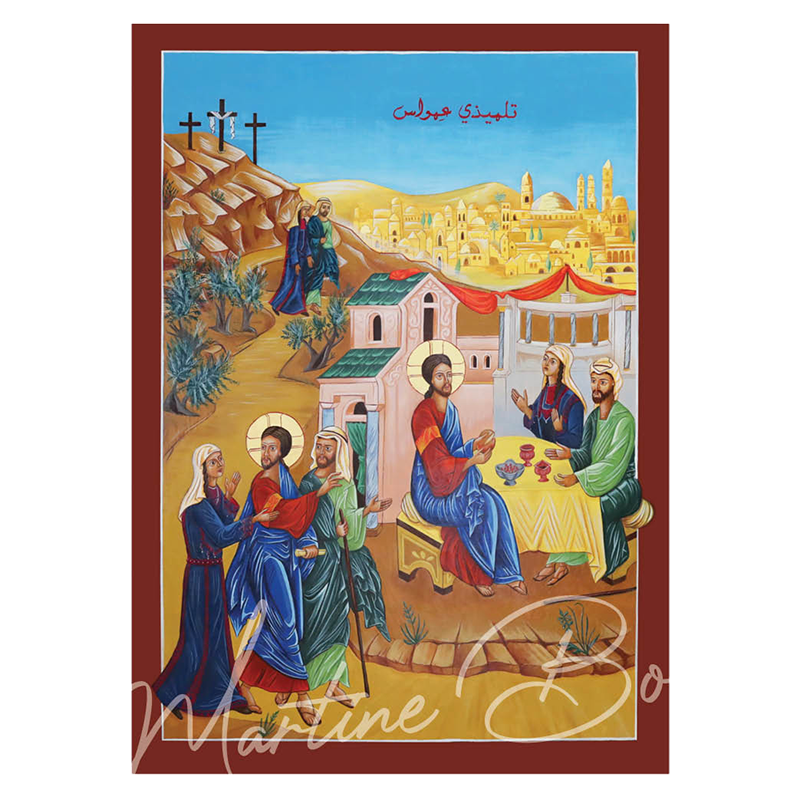
The icon of the two disciples of Emmaus encapsulates the journey of every person who walks a synodal path with the Church. It is a journey where one meets oneself in frustration and hope, meets the other wherever they are on their path, and meets the Lord who reveals Himself, giving our journey value, meaning, and purpose. The encounter of the two disciples is the meeting of every community with the Lord in the Mass—a community that carries its worries and burdens to meet the Lord, to listen to His Word and teachings, and to partake in His Body and Blood in the mystery of the Eucharist. From there, they depart carrying the hope of His resurrection to bring joy back to despairing hearts.
At the foot of the cross, the Lord of Life gave up His spirit. This happened near Jerusalem, which longs for its reality to match the meaning of its name, “City of Peace.” The night of faith descends upon wounded hearts, filling them with fear and despair. There is no hope, no promise. The dreams of the two disciples have evaporated, for the story of their hero has been written by the cross, and their teacher, “a man who was a prophet, powerful in word and deed before God and all the people,” is now laid in the tomb.
For them, everything ended when “everything was finished.” The height of Mount Golgotha is nothing but a symbol of the harsh despair the two disciples are experiencing. The truth of the resurrection and redemption is present despite the pain and death, and the white cloth is a symbol of the life that promises the dawn of the resurrection.
The road back to Emmaus is characterized by a sense of emptiness that symbolizes the feeling of despair and abandonment the disciples are living. Even the olive trees, a symbol of hoped-for peace and blessing, have become for them, after the death of their teacher, a garden that bears witness to their fear, turmoil, and the struggle of their hopes—just as the olive grove bore witness to Jesus’ final agony on the night he was betrayed. This is our path when we come burdened with the weight of our days to cast them before the Lord in Mass.
In the icon, the two disciples bear the features of the people of Palestine, a people wounded by conflicts and strife that have stolen the dreams of its people and the ambitions of its youth. In the green color of the clothing worn by the disciple Cleopas, we see a connection and rootedness in the land and the homeland, and a symbol of life and continuity for a people who reject death, because they are the children of a land that embraced the Lord of Life. With the staff he carries, we understand that the journey toward a peaceful Jerusalem will not stop, even if it is delayed by the pain of death and despair. And from the traditional Kufiyyah on his head, we understand the deep connection with Christ, who came to live among us, in our history and in our reality.
With the woman, a partner on the journey, in its ascent and descent, we see a complementary element in the iconographic scene and in its contemporary reading. She wears the traditional Palestinian dress. With a color that represents wounded humanity, she wears blue, and with the color of divinity, she adds red to her dress, symbolizing the heaven she longs to live in her homeland. Her dress symbolizes the partnership called to live both the pains of the earth and the glory of heaven. With the white headscarf, she covers her head as a symbol of dignity and modesty.
In the heart of their distress and despair, Jesus drew near and began to walk with them, matching their pace. Jesus, the Son of God crowned with a halo of glory, communicates with the disciples through his eyes, his words, his hands, and his heart. He wears red, the color of divinity. And with the blue cloak, he confirms that God took on human flesh, embracing our humanity in its weakness, pain, and death, becoming like us in every way except sin. With his right hand, he blesses, forming with his fingers the letters Alpha and Omega (in Greek), affirming that he is the beginning and the end. With his other hand, he carries the Holy Scriptures, to be a reminder for the disciples who were “slow of understanding, and slow of heart to believe.” Their eyes were prevented from recognizing him. So he began to interpret for them what was said about himself in all the Scriptures, beginning with Moses and all the prophets.
For Jesus is not a stranger to Jerusalem; He knows it by its history, its reality, and its coming glory. Its roads quenched their thirst with his blood, the halls of its temple listened intently to his words, and its people rejoiced in welcoming him and were healed by his touch.
In the first part of the Mass, the Church presents us with the Word of God in the readings and the homily, which explain the scriptures and make us feel at home in the “Jerusalem” of our lives, where God dwells among his people.
We continue the journey with the two disciples, who face the coming of evening, adding darkness and ignorance to their inability to recognize the Lord. We stop with them before the house where the Lord enters to “stay with them.” He “took the bread, gave thanks, broke it, and gave it to them.” Then their eyes were opened, and they recognized him. The event of the breaking of the bread happened inside the disciples’ home. This is symbolized by the red cloth. The buildings in the background of this event are a symbol of the disciples’ house, which became linked to the Temple of Jerusalem, for this home had become a Holy of Holies with the presence of the Risen Christ in it, and each of the two disciples became an ark of the covenant, carrying the glory, covenant, and faithfulness of the Lord.
The features of the two disciples are characterized by the warmth of Palestinian hospitality, and they open their hands in a sign of gratitude, for the Eucharist is a sacrifice of thanksgiving that makes the believer a partner in the body and blood of Christ and with his mystical body, which is the Church. Therefore, we see the disciple’s staff thrown on the ground, because he has met the one who supports his weakness and strengthens his resolve. With the breaking of the bread, the two disciples experienced what we experience in the mystery of the Eucharist. In their union with Christ, knowledge was no longer tied to the physical eye but transcended the visible to meet Christ in a sacramental encounter—an encounter that transcends time and space, an encounter that heals and soothes, pours out hope, and confirms faith, calling them once again.
Just as Mary rose and went with haste to the hill country to a town in Judah after she received the Annunciation and was carrying Christ in her womb, so she went to carry the fruit of her womb in a visit and service to her kinswoman Elizabeth. Similarly, the two disciples of Emmaus, after meeting the Risen Christ and having him dwell within them through his Word and the mystery of the Eucharist, “rose that same hour and returned to Jerusalem.” We see them returning to Jerusalem, to the place where pain and death had failed them, to live a new synodal encounter with the eleven who had learned of the Lord’s resurrection, and they told them what had happened on the road, and how they had recognized Jesus in the breaking of the bread.
“Let the bells of return ring out,” filled with the presence of the Risen Christ, the two disciples returned to Jerusalem, just as every believer returns to their world and their surroundings after every Mass. For Jerusalem, like our lives, outwardly resembles what it was before the death and resurrection of Christ—people, houses, temples, streets, and markets that form a space for meeting, openness, civilization, and also for conflicts and strife. But in reality, and with the event of the resurrection, Jerusalem has become what it is, a city beyond the boundaries of time and space, its golden color merging with the color of the sky, because it carries a final, eschatological dimension: the Heavenly Jerusalem.
The New Jerusalem is a synodal city because it is a symbol of the Church prepared as a bride for her bridegroom. It is the dwelling place of God with his people.
The story of the two disciples of Emmaus holds within it a great and important event on both the individual and communal levels. It is the story of a synodal journey that we live with Christ despite the bitterness of reality, a journey where we move from the Golgotha of death to the paths of the Word and the joy of sharing in the resurrection, toward the New Jerusalem. It is a journey that makes our personal lives a shared thanksgiving with the sacrifice of the Lamb. And from our Church’s journey, a communion with the mystery of Christ risen from the dead, so that we may become witnesses to the resurrection.
“أيقونة تلميذي عماوس”
مع الأب نيقولا عقيقي ر.ل.م
تختصر إيقونة تلميذي عماوس، مسيرة كلّ إنسان يسير مع الكنيسة مسيرة سينودوسيّة، مسيرة يلتقي بها مع نفسه في إحباطه ورجائه، مع الآخر حيث هو من مسيرته ومع الربّ الذي يظهر لنا ذاته، فيعطي لمسيرتنا القيمة والمعنى والهدف… لقاء تلميذي عماوس هو لقاء كلّ جماعة مع الربّ في القدّاس، جماعة تحمل همومها وتعبها معها لتلتقي بالرب، فتسمع لكلمته وتعاليمه وتشترك بجسده ودمه في سرّ الإفخارستيا، فتنطلق حاملةً رجاء قيامته لتعود حاملةً الفرح للقلوب اليائسة…
عند أقدام صليب، أسلم عليه الروح، من هو سيّد الحياة، وعلى مقربة من أورشليم التي تترجى أن يتماهى واقعها مع معنى اسمها “مدينة السلام”… إنّه ليل الإيمان يهبط على القلوب الجريحة، يملأها الخوف والضياع. لا أمل، لا رجاء… أحلام تلميذين تبخّرت، فحكاية البطل، كتب الصليب سطورها، وها هو معلّمهم “الرجل النبيّ القويّ بِالقَوْلِ وَالفِعْل، قُدَّامَ اللهِ وَالشَّعْبِ كُلِّهِ” موضوع في القبر.
“بالنسبة لهما، لقد انتهى كلّ شيء، حين “تمّ كلّ شيء” وما ارتفاع جبل الجلجلة سوى رمز لقساوة الإحباط الذي يعيشه التلميذان. إنّ حقيقة القيامة والفداء، حاضرة رغم الألم والموت، والمنديل الأبيض هو رمز لتلك الحياة التي تعد بفجر القيامة.
إنّ درب العودة نحو عمّاوس، اتشحت بطابع الفراغ الذي يرمز لشعور اليأس والخذلان الذي يعيشه التلميذان، وحتى شجر الزيتون، رمز السلام المرتجى و البركة، صار لهما بعد موت معلّمهم، بستانًا يشهد لخوفهما واضطرابهما ونزاع آمالهما، كما شهد بستان الزيتون لنزاع يسوع الأخير في الليلة التي أسلم فيها… هي دربنا حين نأتي محمّلين بثقل أيامنا لنطرحها أمام الرب في القداس.
في الإيقونة، يحمل التلميذان ملامح أهل فلسطين، ملامح شرق جرّحته النزاعات والاضطرابات، وسلبت أحلام شعبه وطموحات شبابه. بلون الثياب الخضراء التي يرتديها التلميذ كليوباس، نرى ارتباط وتجذّر بالأرض والوطن، ونرى رمز للحياة والاستمراريّة لشعب يرفض الموت، لأنه ابن أرضت احتضنت سيّد الحياة. ومع العصا التي يحملها نفهم بأن المسيرة نحو أورشليم السلام لن تتوقف، حتى لو أخّرها ألم الموت واليأس. ومن الكوفيّة التقليديّة على رأسه، نفهم الارتباط الوثيق بالمسيح الذي حلّ بيننا، في تاريخنا وفي واقعنا.
مع المرأة، شريكة المسيرة، في صعودها وفي نزولها، نرى تكامل في المشهد الإيقونوغرافي وفي قراءته الآنيّة. إنها ترتدي اللباس التقليدي للمرأة الفلسطينيّة، من لون ومن لون الإنسانيّة المجروحة ترتدي اللون الأزرق، وبلون الألوهة تضيف لثوبها اللون الأحمر رمزًا السماء التي تتوق أن تعيشها في وطنها. بثوبها ترمز للشراكة المدعوّة أن تعيشها آلام الأرض ومجد السماء. بالمنديل الأبيض تغطي رأسها رمزًا للوقار وللحشمة.
في قلب المحنة والإحباط، اقترب يسوع منهما وراح يسير معهما، وعلى وقع خطاهما. يسوع ابن الله مكللاً بهالة المجد، يتواصل مع التلميذين بعينيه وكلامه ويديه وقلبه… يرتدي اللون الأحمر، لون الألوهة. وبالمعطف الأزرق يؤكّد بأنّ الله لبس جسد الإنسان، فتبنى إنسانيّتنا في ضعفها وألمها وموتها، فشابهنا بكلّ شيء ما عدا الخطيئة. بيده اليمنى يبارك فرسم بأصابعه حرفي الألف والياء (باليونانيّة)، فيؤكّد أنّه البداية والنهاية. وبيده الأخرى يحمل الأسفار المقدّسة، لتكون منبّهًا للتلميذين عَدِيـمَيِ الفَهْم، وَبَطِيئَيِ القَلْبِ في الإِيْمَانِ. اللذين أمسكت أعينهما عن معرفته. لذا راح يفسَّرَ لَهُمَا مَا يَتَعَلَّقُ بِهِ في كُلِّ الكُتُبِ الـمُقَدَّسَة، مُبْتَدِئًا بِمُوسَى وَجَمِيعِ الأَنْبِيَاء.
فيسوع ليس غريبًا عن أورشليم، فهو يعرفها ببتاريخها وبواقهعا وبمجدها الآتي، فطرقاتها روت عطشها بدمائه، وأروقة هيكلها أمعنت بالسمع إلى كلامه، وجموع أهلها تهلّلت باستقباله وشفيت بلمسة شفائه…
في القسم الأوّل من القداس، تقدّم لنا الكنيسة كلمة الله في القراءات والعظة التي تشرح لنا الكتب وتجعلنا غير غرباء عن أورشليم حياتنا، حيث مسكن الله بين شعبه.
ونتابع المسيرة مع التلميذين، الذين يواجهان حلول المساء ليزيد على إمساك أعينهما عن معرفة الربّ ظلمةً وجهلاً. لنتوقف معهما أمام البيت حيث يدَخَل الرب لِيَمْكُثَ مَعَهُمَا. ويأَخَذَ الـخُبْزَ، ويبَارَكَ، وَيكَسَرَ، وينَاوَلَهُمَا. فتنفتح أعينهما ويعرفاه. إنّ حدث كسر الخبز حصل داخل منزل التلميذين، هذا ما يرمز إليه القماش الأحمر، أمّا الأبنية في خلفيّة هذا الحدث فهي رمز لبيت التلميذين الذي أصبح مرتبطًا بهيكل اورشليم، فهذا المنزل قد أصبح قدس أقداس بحلول المسيح القائم فيه، وأصبح كلّ من التلميذين تابوت عهد يحمل مجد الربّ وعهده وأمانته…
تتسم ملامح التلميذين بحفاوة الترحاب و الضيافة الفلسطينيّة ويفتحان أيديهما علامة الامتنان، فالافخارستيا هي ذبيحة شكر، تجعل المؤمن بشراكة في جسد ودم المسيح ومع جسده السريّ وهو الكنيسة. لذا نرى عصا التلميذ مرميّة على الأرض، لأنّه التقى بمن يسند ضعفه ويقوّي عزيمته. مع كسر الخبز عاش التلميذان ما نعيشه في سرّ الافخارستيّا، وباتحادهما مع المسيح لم تعد المعرفة مرتبطة بعين الجسد، بل تخطّت المرئي لتلتقي بالمسيح لقاء أسراري، لقاء يتخطى الزمان والمكان، لقاء يشفي ويبلسم، يسكب الرجاء ويثبت الإيمان… فيدعو من جديد.
كما قَامَتْ مَرْيَمُ وَذَهَبَتْ مُسْرِعَةً إِلى الجَبَل، إِلى مَدِينَةٍ في يَهُوذَا.بعد أن تلقت البشارة وحملت المسيح في أحشائها، فتوجّهت لتحمل ثمرة أحشائها في زيارة وخدمة نسيبتها اليصابات، كذلك فعل تلميذا عماوس بعد أن التقيا بالمسيح القائم، وسكن فيهما بكلمته وبسرّ الافخارستيا. فقَامَا في تِلْكَ السَّاعَةِ عَيْنِهَا، وَرَجَعَا إِلَى أُورَشَلِيم. نراهما عائدين إلى القدس، إلى حيث خذلهما الألم والموت، ليعيشا لقاءًا سينودوسيّا جديدًا مع الأحد عشر الذين عرفوا بقيامة الرب، فيخبرانهم بِمَا حَدَثَ في الطَّرِيق، وَكَيْفَ عَرَفَا يَسُوعَ عِنْدَ كَسْرِ الـخُبْز.
“أجراس العودة فلتُقرع”، ممتلئين من حضور المسيح القائم، عاد التلميذان إلى القدس، كما يعود كلّ مؤمن إلى عالمه ومحيطه بعد ملّ قدّاس. فالقدس كما حياتنا، تشبه بالظاهر ما كانت عليه قبل موت المسيح وقيامته، أناس ومنازل ومعابد وشوارع وأسواق تشكّل مساحة للتلاقي والانفتاح والحضارة وأيضًا للصراعات والنزاعات… ولكن بالحقيقة ومع حدث القيامة، أصبحت القدس بما هي عليه، مدينة أبعد من حدود الزمان والمكان، تتماهى بلونها الذهبي مع لون السماء، لأنها تحمل بعدًا نهيويًا إسكتولوجيًّا: أورشليم السماويّة.
أورشليم الجديدة، هي مدينة سينودوسيّة، لأنّها رمز للكنيسة المهيأة كعروس لعريسها. إنّها مسكن الله مع شعبه.
إن قصة تلميذَي عمّاوس تحمل في طياتها حدثًا كبيرًا ومهمًا على الصعيدَين الفردي والجماعي، إنها حكاية مسيرة سينودوسيّة نعيشها مع المسيح، رغم مرارة الواقع، مسيرة نتنقل فيها من جلجلة الموت إلى دروب الكلمة وفرح المشاركة بالقيامة، نحو أورشليم الجديدة. مسيرة تجعل حياتنا الشخصية مشاركة شكر مع ذبيحة الحمل. ومن مسيرتنا الكنسيّة شركة بسر المسيح القائم من الموت، فنغدو فيها شهودًا للقيامة.
This is a detailed description of the product, including its features, materials, and any other relevant information.
We offer free shipping on all orders over $100. For orders under $100, a flat rate shipping fee of $10 applies. All items are shipped within 3-5 business days. If you are not satisfied with your purchase, you can return it within 30 days for a full refund.