 From Martine Icons Atelier… to You
L’Unité D’Idée: A Theological and Artistic Commentary on the Icons of Saint Charbel Church, Ehden
10/08/2023
Lebanese Artist & Iconographer
Martine Icons | Vibrand Studio
“The icon is a Gospel written by the Holy Spirit, and an inseparable part of the Christian Liturgy and Faith as a whole.”
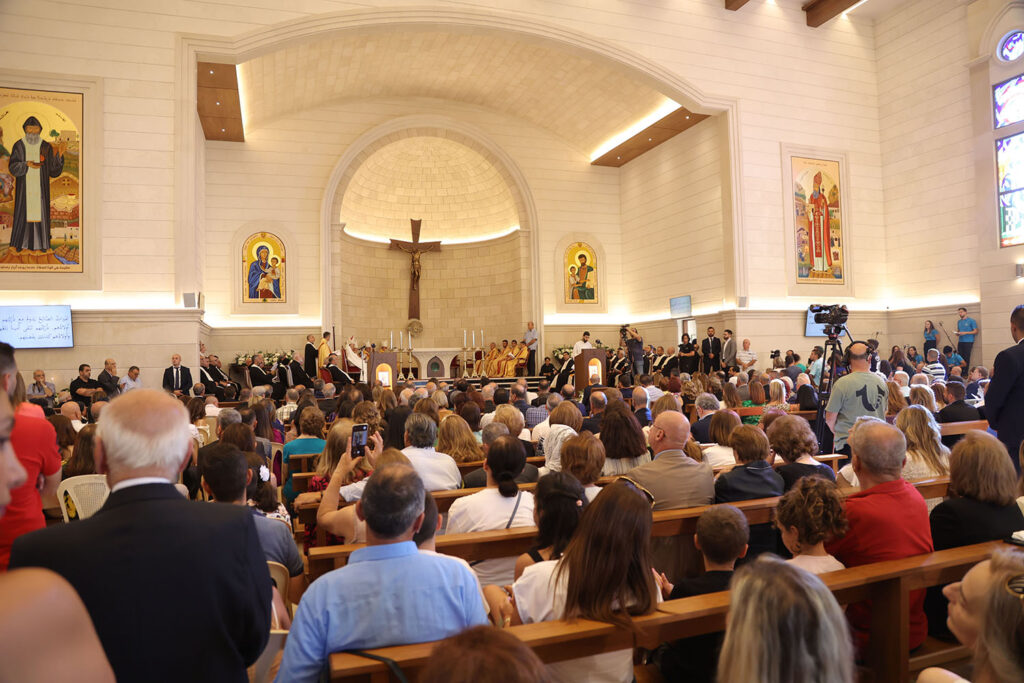
For me, icons are not merely decorative elements within our churches. They are visual theology, and their creation is a spiritual discipline.
What distinguishes the icons we create for our Maronite churches from others is the unity of a single idea — l’Unité D’idée.


The icons are the result of a collective effort whose goal was to create one unified idea in terms of form, drawing, color palette, and a unification of their meanings and content. This collaborative process ensures that each piece is a harmonious part of a larger spiritual vision, speaking a consistent language of faith and tradition.
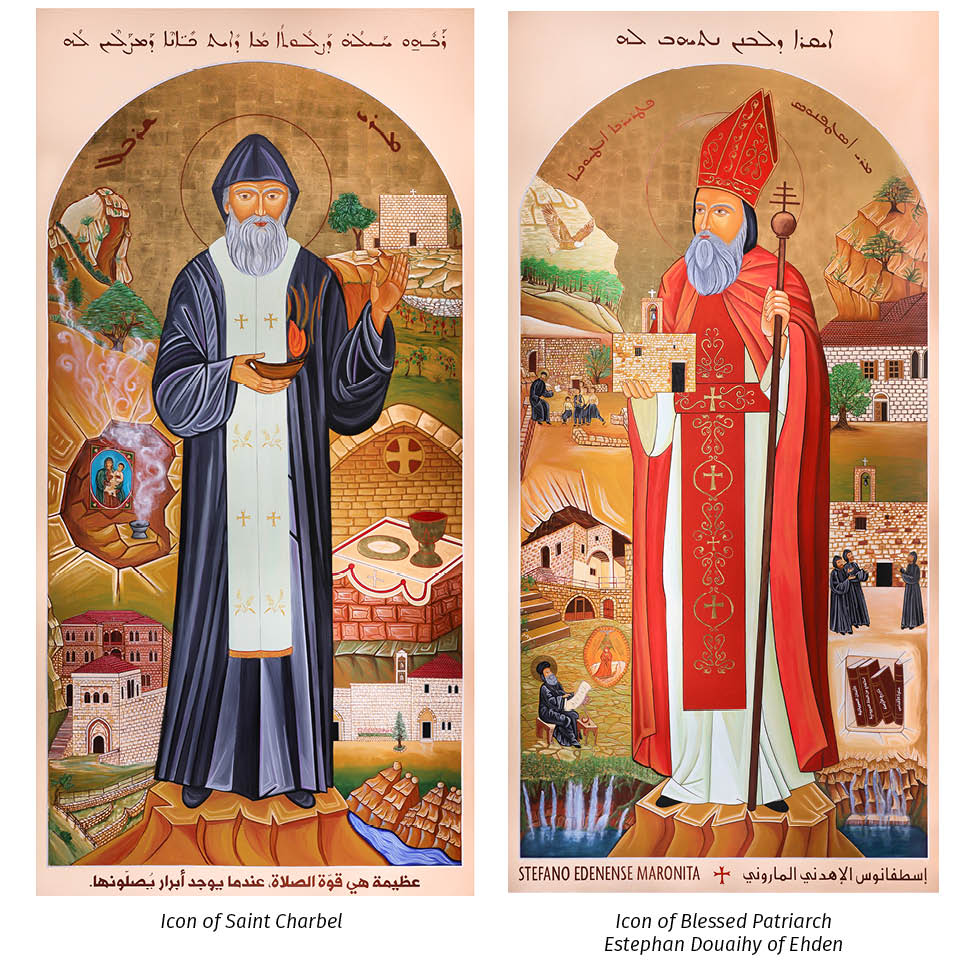
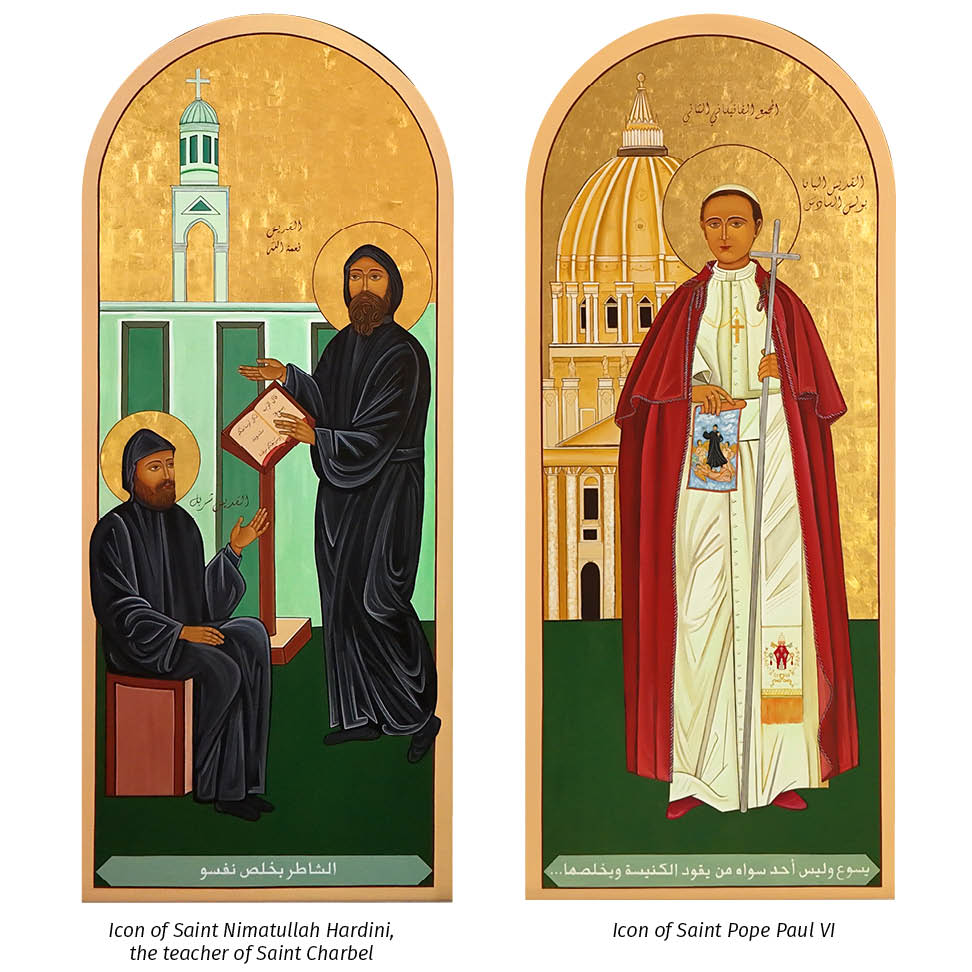
Short and concise explanations of the icons, inspired by a detailed and in-depth commentary prepared by the Carmelite Sisters of the Monastery of the Mother of God and Unity – Harissa.
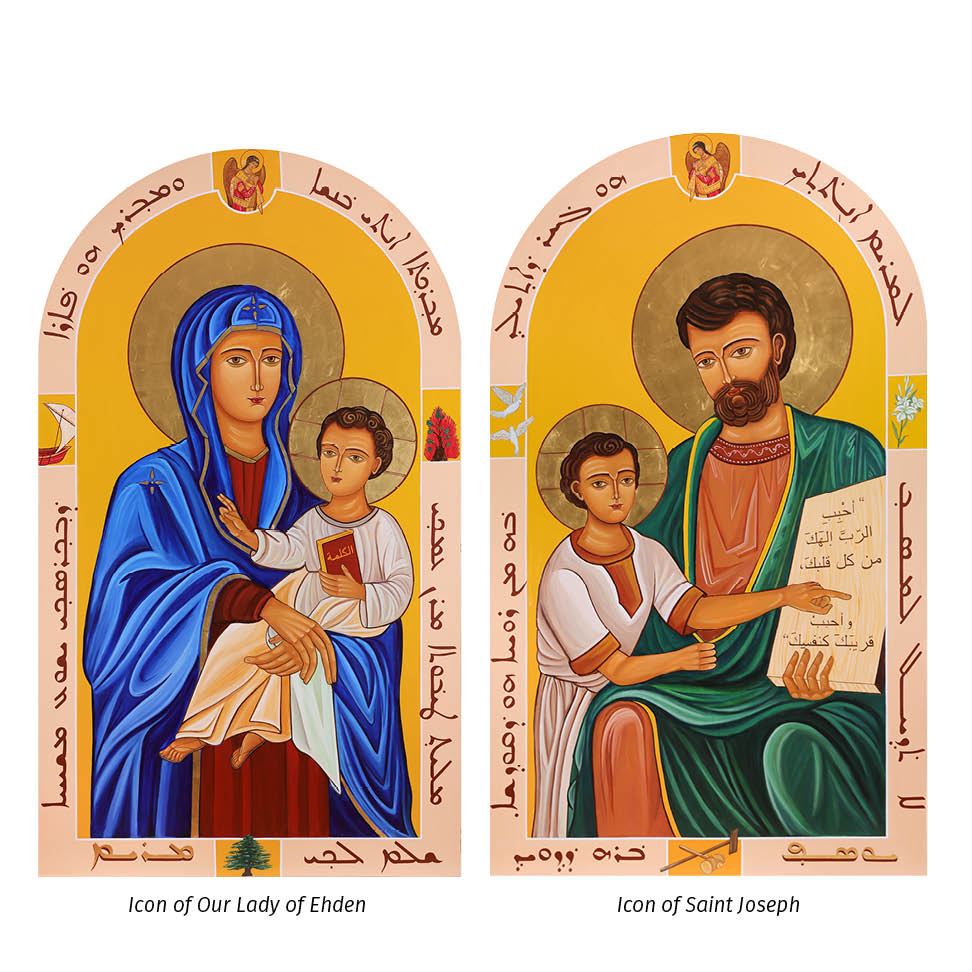
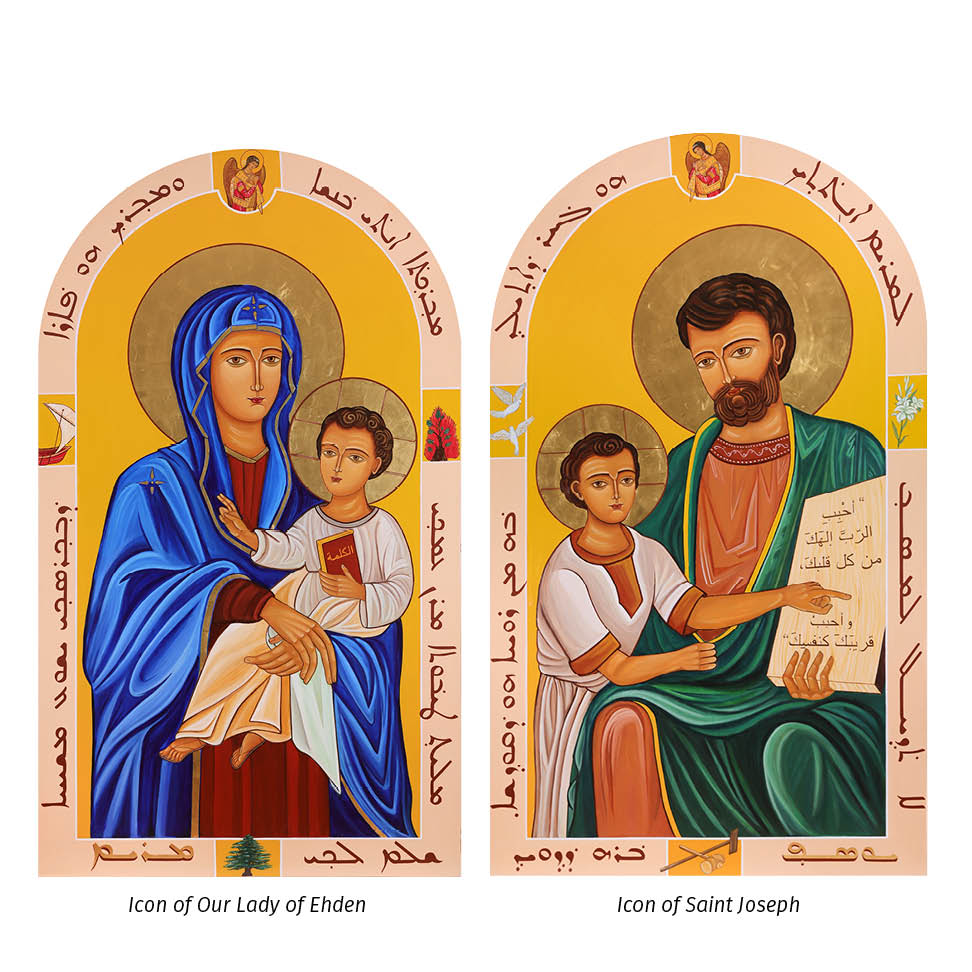
Icon of Our Lady of Ehden
Based on the detailed description you provided, here is a concise summary of the key points about the Icon of Our Lady of Ehden.
The icon is a modern rendition crafted in the style of the ancient “Our Lady of Ilige” icon, which was itself influenced by the Western-style “Salus Populi Romani.” This synthesis gives the icon a unique blend of Eastern and Western artistic traditions.
At its core, the icon is rich with symbolism:
- The dominant blue robe of the Virgin Mary represents her title as “Lady of the Heavens.”
- The three stars on her head and shoulders signify her perpetual virginity.
- The white handkerchief she holds is a symbol of her noble status.
- The child Jesus, shown holding a book inscribed with “The Word,” is the focal point, with his eyes and gesture directing the viewer to his mother.
- The surrounding miniatures on the frame add further layers of meaning, depicting the angel Gabriel as a messenger, a sailing ship representing the Church, the Burning Bush symbolizing the divine mystery of Christ’s birth, and a cedar tree affirming the Virgin Mary’s connection to Lebanon.
The icon serves as a theological lesson in art, encouraging believers to seek salvation through the intercession of the Mother of God.
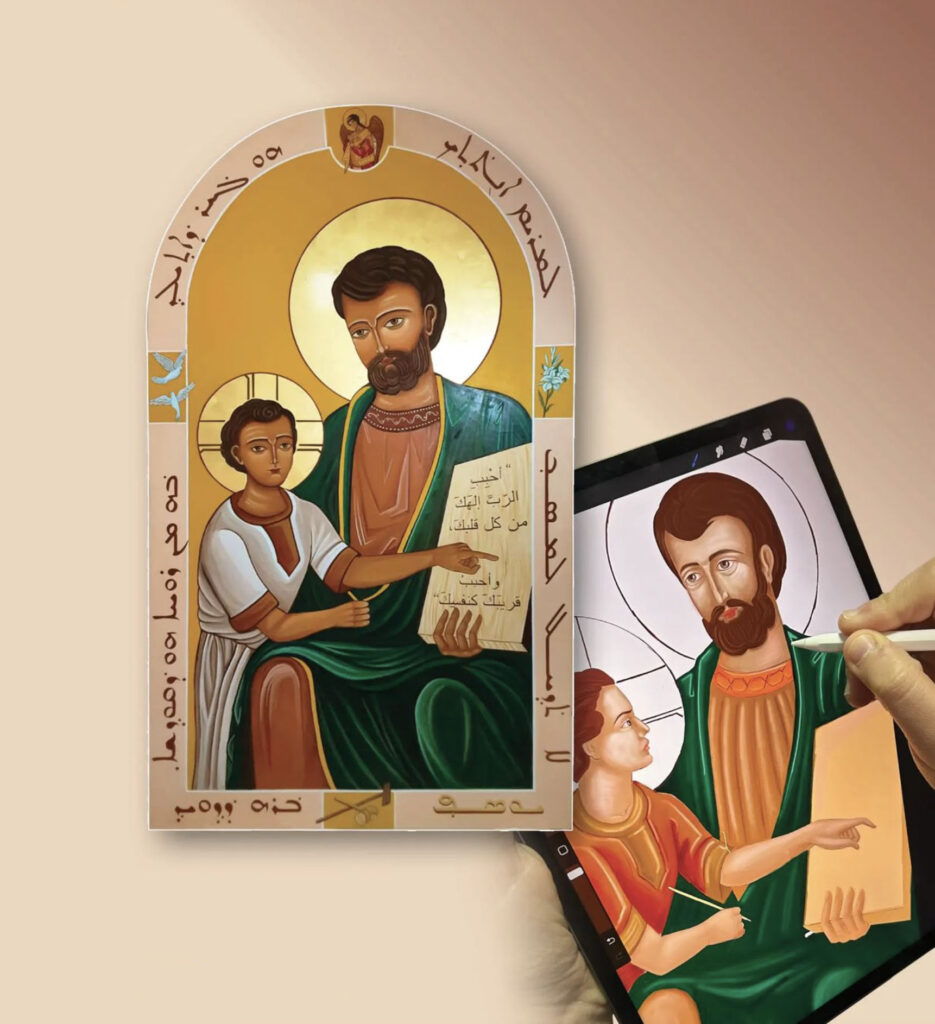
The icon of Saint Joseph
The icon portrays Saint Joseph with a paternal gaze, guiding believers toward a righteous path, while the child Jesus points to the biblical commandments of loving God and one’s neighbor. Jesus’s reliance on Joseph signifies the latter’s role as the earthly father and protector of the “Incarnate Word of God.” The color of Joseph’s green and earthy-red garments symbolizes life and his spiritual discipline, reflecting his role as a guide for contemplative prayer. The white robe of Jesus and the cross on his halo confirm his divinity.
Four miniatures on the frame enhance the icon’s meaning:
- An angel represents the divine presence and Joseph’s unique mission.
- Two doves symbolize Joseph’s legitimate yet virginal fatherhood.
- A lily signifies the purity of the Virgin Mary, whose presence is integral to the scene.
- A carpenter’s square and hammer point to Joseph’s humble profession, through which he provided for his family, and to his role as the patron of workers.
This icon serves as a profound theological message, showcasing Saint Joseph as a loving father, a spiritual guide, and a protector of the Church.
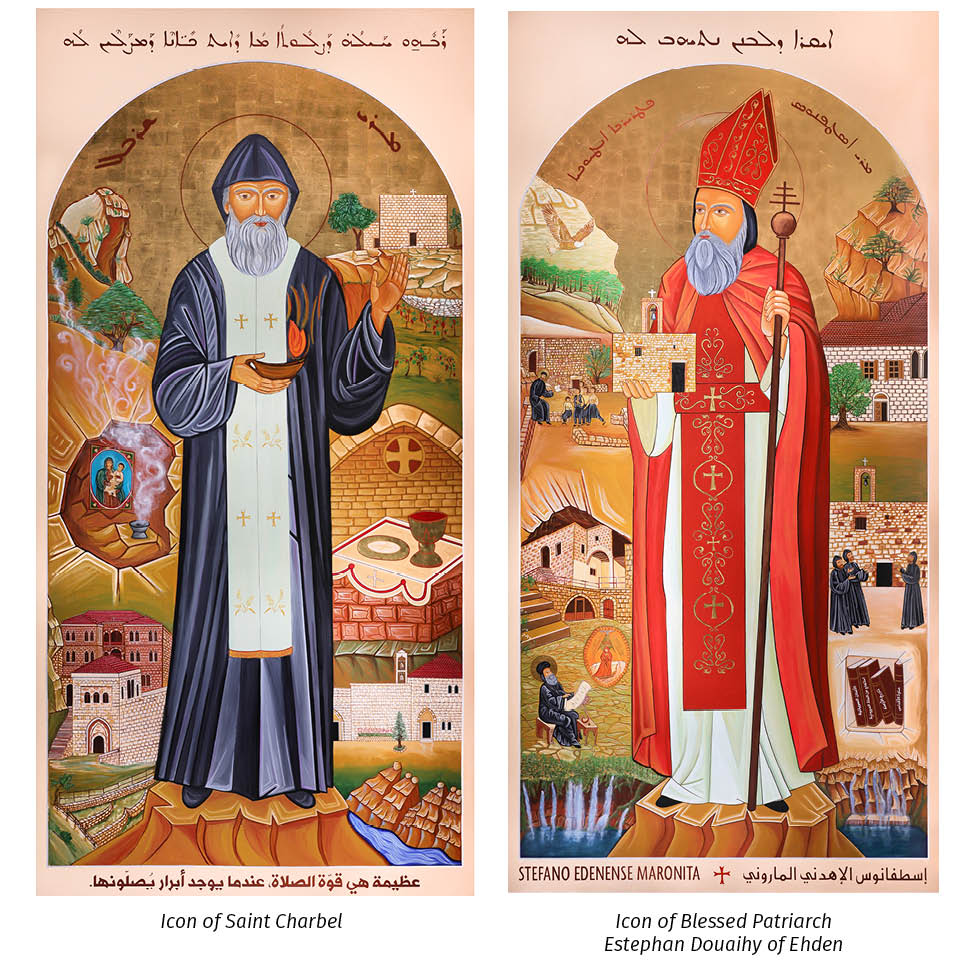
The Icon of Saint Charbel
A Syriac-style icon rich with spiritual symbolism. It portrays the saint in a state of deep contemplation, with eyes downcast yet his spiritual vision fixed on God. His open left hand is ready to receive grace, while his right holds a lamp with a flame at heart level, symbolizing his heart’s love for Jesus, which was so intense it allowed him to light his lamp with water instead of oil.
The icon’s frame contains four symbolic miniatures: grapevines that represent his self-sacrifice and participation in Christ’s redemption, and the monasteries and caves of his life’s journey (Annaya, Qannoubine, and Bkaakafra). The inclusion of a cedar tree above the cave links him to the Virgin Mary and the spiritual heritage of Lebanon. The icon summarizes its message with a powerful inscription in Syriac and Arabic: “Great is the power of prayer, when there are righteous people who pray it.” It serves as a visual sermon on the power of faith and solitude.
The Icon of Blessed Patriarch Estephan Douaihy of Ehden
is a theological and historical portrait, revealing the saint’s spiritual depth and unwavering pastoral mission. Painted in the traditional Syriac style, it presents a figure of strength and grace, holding his pastoral staff on the rock of Peter and the Church in his hands, symbolizing his firm belief in the papacy.
The icon’s symbolism delves into Douaihy’s profound spiritual life. His eyes, though once blind, are shown illuminated by divine light, representing his deep contemplative life. This is further depicted by an eagle soaring towards divine glory and a scene of him praying in the Monastery of Qannoubine, a place significant to his life. A scroll in his hand is inscribed with a phrase from the Song of Solomon, which he attributed to the Virgin Mary, “Come, my beloved, from Lebanon, that I may crown you with a crown of glory.”
His active apostolic work is also highlighted: he is shown teaching children and granting a monastery to the founders of new monastic orders. The books he authored are a testament to his commitment to spiritual education. The icon uses local elements, such as the waterfalls of Ehden, to symbolize his fertile intellectual and spiritual legacy, born from his twin loves for God and his neighbor.
The icon’s colors are deeply symbolic: red for sacrifice, white for pure faith, and green for eternal life. These elements—along with images of the St. Sarkis Monastery where he was ordained, a cedar tree, and the phrase, “The glory of Lebanon was given to him,”—all underscore his life as a sacrificial offering. The icon ultimately teaches that his life was built on three pillars: the Eucharist, the Virgin Mary, and the primacy of St. Peter.
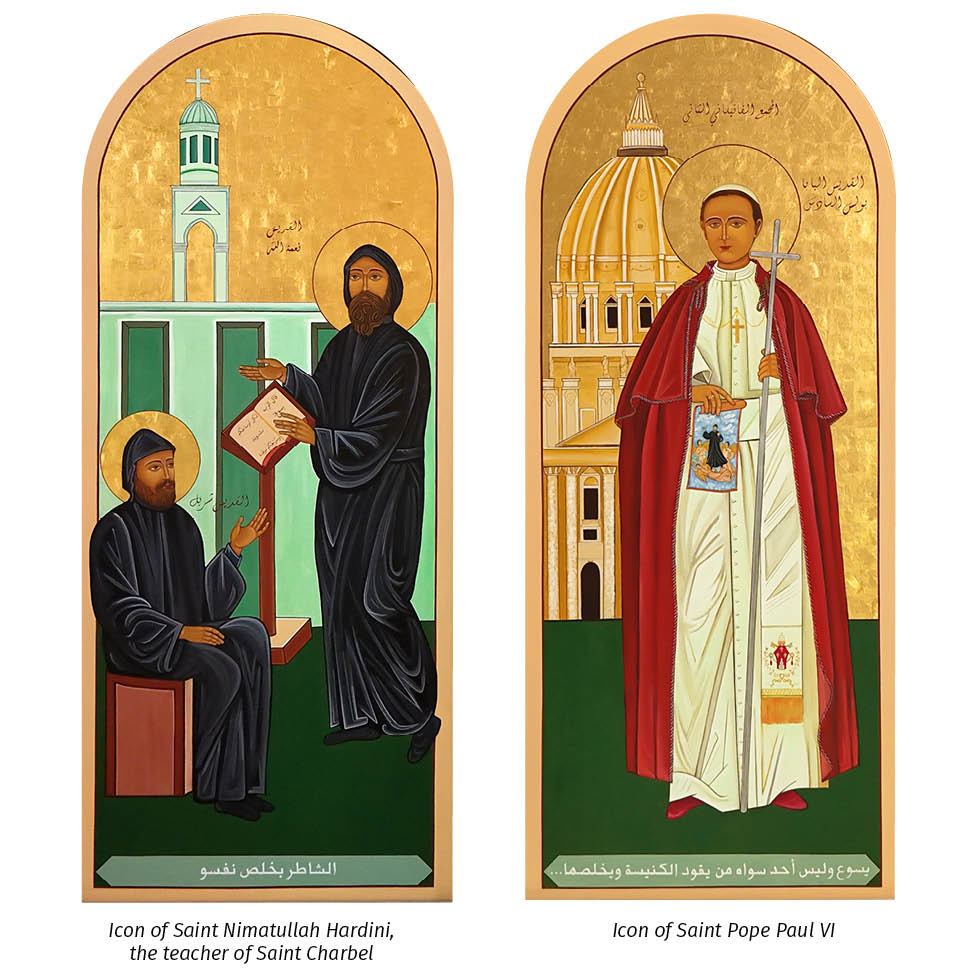
Icon of Saint Nimatullah Hardini
The provided text is a detailed analysis of the Icon of Saint Nimatullah Hardini, the teacher of Saint Charbel, in St. Charbel Church, Ehden. The icon is styled after a medieval depiction of “Christ in the Synagogue of Nazareth,” emphasizing Hardini’s role as a teacher of divine truth.
Saint Nimatullah is shown standing, his posture mirroring that of Christ. However, his right hand is held open and raised upward, signifying that he is a humble receiver of God’s word, not the source of it. This gesture is also a nod to the “Platitera” icon of the Virgin Mary, highlighting Hardini’s devotion to her and his role as a spiritual disciple. This central symbolism conveys that true teaching comes from first listening to and living by God’s word.
The icon also portrays Saint Charbel as Hardini’s disciple, adopting the same posture of receptivity. This visual connection highlights their deep spiritual bond and shared commitment to contemplation. Both saints are depicted outside the walls of the monasteries where they lived (Kfifan and Annaya), as if in an eternal, boundless space. This emphasizes that their spiritual work and connection with God transcend earthly time and place.
Further enriching the icon’s meaning are several symbolic details: the open book with the inscription “Be dressed in readiness and keep your lamps burning,” which encapsulates Hardini’s famous motto, “The clever person saves himself.” The bell dome symbolizes God’s voice calling all to holiness. Ultimately, the icon serves as a powerful call to all Christians to live a life of dedication, contemplation, and unwavering faith, guided by the examples of these two great saints.
Icon of Saint Pope Paul VI
The Icon of Saint Pope Paul VI commemorates the significant events of Saint Charbel’s beatification and canonization. Painted in the Syriac iconographic tradition, it shows Pope Paul VI holding an image of Saint Charbel, symbolizing their spiritual connection and the Pope’s pivotal role in elevating the Lebanese saint. This visual narrative captures the moment when the Church of Rome honored an Eastern monk, uniting the traditions of the East and West.
The icon’s background features St. Peter’s Basilica, a powerful reminder of the Second Vatican Council, which concluded with Charbel’s beatification. Paul VI used this synchronicity to highlight the importance of prayer, asceticism, and humility as essential Christian virtues. He also emphasized that this event was a symbol of unity, bridging the gap between Eastern and Western Christianity.
A key inscription at the bottom of the icon, “Jesus, and no one else, guides and saves the Church,” reflects Pope Paul VI’s unwavering faith. It encapsulates his personal motto and his resilience in leading the Church, secure in the promise that Jesus would never abandon it.
In his own words, the Pope recognized Saint Charbel as a divine gift, a source of inspiration and intercession for all Christians. The icon, therefore, serves not only as a historical record but also as a visual testament to the power of holiness and the unity of the universal Church. It celebrates how Charbel’s miraculous influence and spiritual example continue to inspire believers in Lebanon and across the globe.
It is with immense gratitude that I acknowledge the collaboration that brings these sacred pieces to life. The icons were written and painted with great cooperation between His Excellency Archbishop Joseph Naffah, Monsignor Estephan Frangieh, the Antonine Sisters, the Carmelite Sisters of the Mother of God and Unity Monastery, and myself.
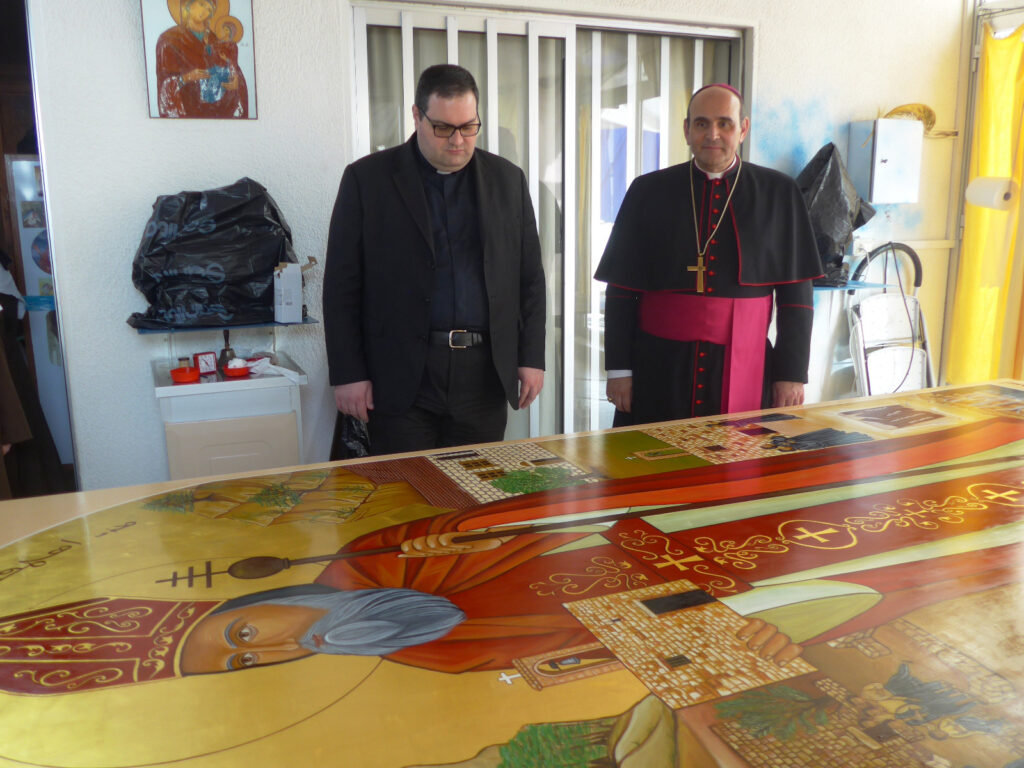
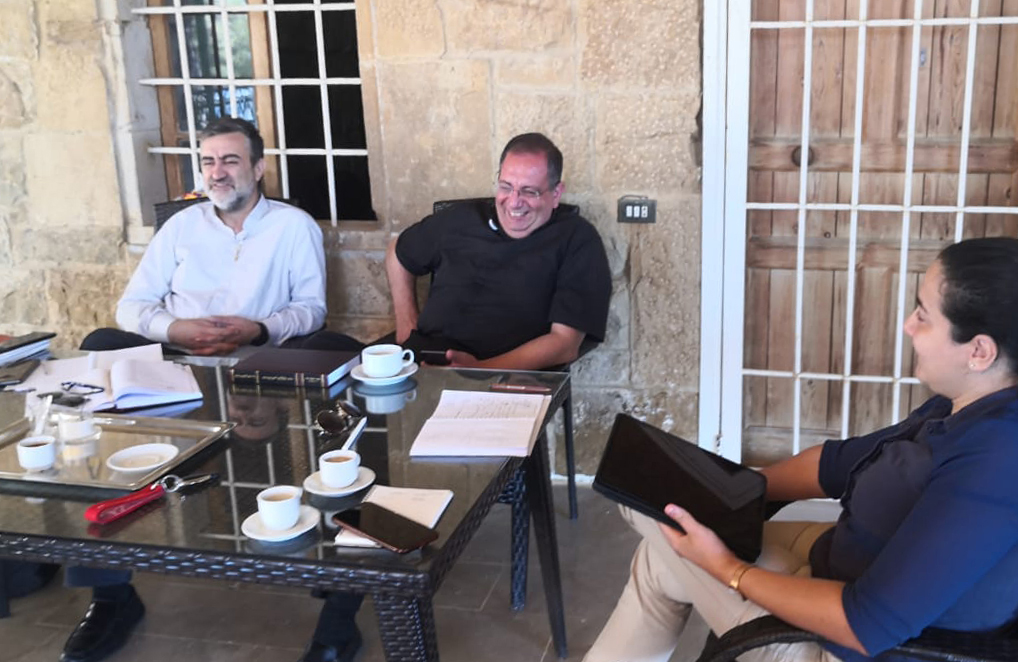
The Papal Nuncio to Lebanon is examining the icon of Patriarch Douaihy in the workshop
of the Carmelite Sisters of the Monastery of the Mother of God and Unity in Harissa.
We invite you to visit the Saint Charbel Church in Ehden to see the stained-glass windows and the six icons by entering the Gate of the Gospel. This shared journey of faith and art is at the very heart of my work at Martine Icons.